
Additional Handling and Oversize Surcharges: The Fees That Blindside Canadian Sellers
Additional handling and oversize surcharges can add hundreds of dollars to a single parcel. Here is how these fees work in Canada and how to audit them.

ShipSherlock Team
If you ship anything bigger than a shoebox, there is a category of carrier fee you need to understand before it understands you. Additional handling and oversize surcharges are among the largest single-parcel fees UPS and FedEx charge, and in 2026 the rules for triggering them got stricter. A package that shipped clean last year can now come back with an extra charge larger than the base shipping rate itself.
Here is how these fees work, what changed this year, and why they belong at the top of your audit list.
What triggers an additional handling surcharge
Both UPS and FedEx apply additional handling fees when a package is awkward for their automated systems. The triggers fall into a few buckets.
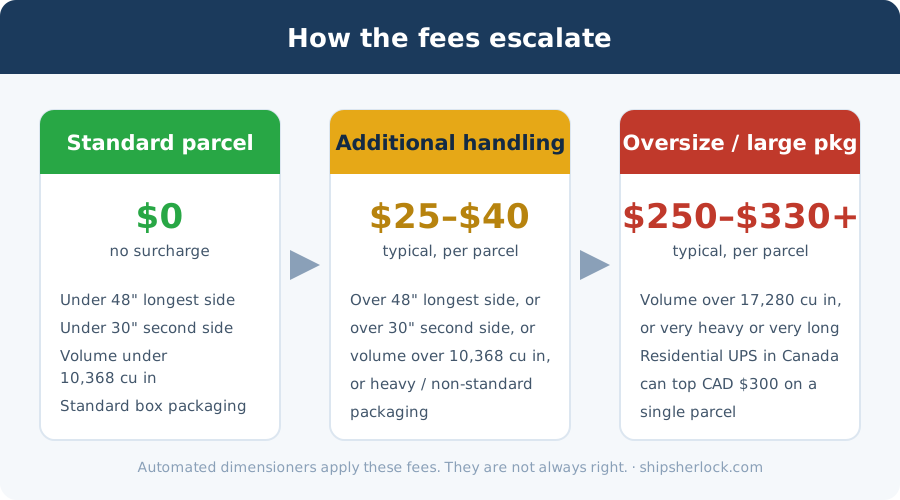
Size. At FedEx, a package typically triggers the fee when its longest side exceeds 48 inches, its second-longest side exceeds 30 inches, or its length plus girth exceeds 105 inches. UPS uses similar dimensional triggers.
Weight. Heavier packages, generally those over the 50 to 70 pound range depending on carrier and service, get flagged for extra handling.
Packaging. Anything not in a standard corrugated box can trigger the fee: wood crates, metal containers, cylindrical items like rolled rugs or posters, or boxes strapped together.
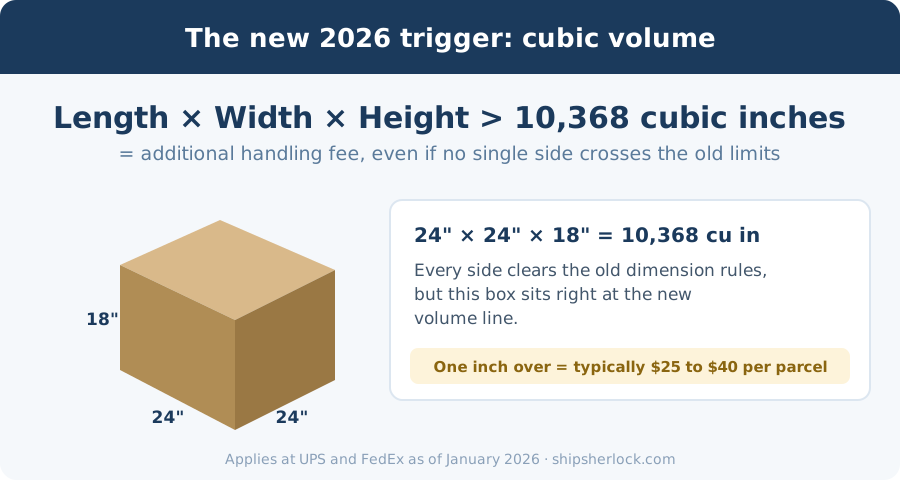
Cubic volume, new for 2026. This is the big change. Both carriers introduced a cubic volume trigger this year: multiply length by width by height, and if the result exceeds 10,368 cubic inches, the additional handling fee applies even if no single dimension crosses the old thresholds. A 24 by 24 by 18 inch box clears every traditional trigger but sits right at that volume line. Plenty of sellers are now paying fees on boxes that were fine in 2025.
When it escalates to an oversize or large package surcharge
Additional handling is the smaller of the two fees. The expensive one kicks in when a package crosses the next tier.
At UPS, the Large Package Surcharge now applies to packages with cubic volume above 17,280 cubic inches or actual weight above 110 pounds. In Canada, the residential version of this fee can run into the hundreds of dollars, in some cases north of 300 dollars on a single parcel. One small mercy: when UPS applies the Large Package Surcharge, it does not stack the additional handling fee on the same package.
FedEx applies its oversize charge at a similar volume threshold, with fees typically in the 250 to 330 dollar range, and separately applies a large package trigger for parcels over 96 inches in length or 130 inches in combined length and girth.
The dollar impact for a typical Canadian seller
Additional handling fees typically run in the 25 to 40 dollar range per package. That sounds manageable until you multiply it. A seller shipping 50 furniture components, sports equipment boxes, or rolled textiles per month at 30 dollars each is paying roughly 1,500 dollars monthly in handling fees, or somewhere in the range of 18,000 dollars a year. If even a handful of those charges are applied incorrectly, and in our experience some percentage typically are, that is real money leaking out of your margins every month.
Oversize fees are worse. A few wrongly flagged parcels per month at 250 to 330 dollars each can quietly add thousands of dollars a year.
Why these charges are worth auditing
These fees are applied by automated dimensioning machines that scan parcels as they move through carrier hubs. The machines are good but not perfect. Soft packages get compressed and measured wrong. A box scanned at an angle reads bigger than it is. A package with a slightly bulged side crosses a threshold it should not.
When a dimensioner gets it wrong, the fee lands on your invoice with no explanation beyond a code and an adjusted dimension. Most sellers never check whether the recorded dimensions match the box they actually shipped. Carriers know this.
The dispute process is straightforward if you have your own dimension records: compare the carrier's scanned dimensions on the invoice against your actual box specs, and challenge any charge where the numbers do not line up. Carriers will reverse charges when you show your box could not have measured what their machine claims.
Three ways to protect yourself
First, know your volume math. Calculate length times width times height for every box size in your lineup and flag anything near 10,368 cubic inches. Sometimes shaving an inch off one side keeps you under the line.
Second, record your packaging specs. Keep a simple list of every box you use with exact dimensions and weights. It is your evidence when a dimensioner disagrees.
Third, audit every invoice. These surcharges hide in the adjustment section of your bill, often weeks after the shipment. If nobody is comparing billed dimensions against actual dimensions, wrong charges get paid by default.
ShipSherlock does that comparison automatically. Connect your carrier accounts and we flag surcharges that do not match your shipment data, then help you file the dispute.
Related guides
Deadlines, eligibility and claim steps for the carriers covered above.
- Canadian Carrier Refund RulesFiling deadlines and eligible services for UPS, FedEx, Canada Post and Purolator, kept current.
- UPS Refund Recovery in CanadaHow UPS Guaranteed Service Refunds work and what the 15-day window covers.
- FedEx Refund Recovery in CanadaClaiming the FedEx Money-Back Guarantee, including the 2026 Canadian reinstatement.
Stop overpaying
Done reading? Start recovering.
ShipSherlock audits every invoice automatically. You pay nothing unless we find money your carrier owes you.