
Peak Season Shipping Surcharges in Canada: What to Audit Before December
Carriers layer demand surcharges on top of normal fees from late September through mid-January. Here is how peak season shipping surcharges work in Canada and what you can still recover.

ShipSherlock Team
Every autumn the carriers quietly change the price of your business. Not the base rate, which they raise in January with plenty of notice, but a second layer of fees that switches on around the end of September and switches off in the middle of January. FedEx calls them demand surcharges. UPS calls them demand and surge emergency fees. Either way, most Canadian sellers only notice them in February, when they look at what Q4 actually cost.
It is late August and the 2026 peak rates are not fully published yet. That makes right now the best window you will get to set up your defences.
What a demand surcharge actually is
A demand surcharge is an extra charge stacked on top of a fee you were already paying. It is not a replacement rate. FedEx is explicit about this in its Canadian rate materials: the demand surcharge is assessed in addition to the base surcharge amount and appears as a separate line item on your invoice.
That separate line item is the useful part. It makes the peak add-on auditable on its own. If a package should never have been flagged as oversize, you dispute the base oversize charge and the demand portion attached to it.
What last peak actually cost
The most recent complete Canadian cycle ran from 29 September 2025 to 18 January 2026, and the published FedEx figures give you a sense of the scale.
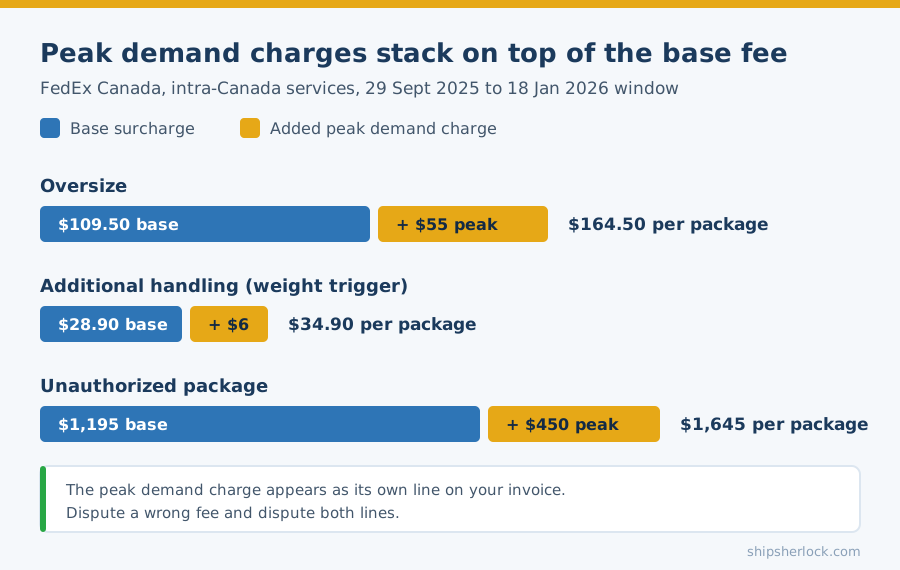
Oversize. Base charge of $109.50 per package intra-Canada, with an additional demand charge of $55 per package on top.
Additional handling. Base charge of $24.90 to $28.90 per package depending on whether it was triggered by dimension, weight, or packaging, plus $6 per package in demand charges.
Unauthorized package. Base charge of $1,195 per package, plus $450 per package in demand charges.
Residential delivery. A separate demand charge applied to intra-Canada services from 27 October 2025 through 18 January 2026.
For 2026, FedEx has confirmed that effective 21 September it will adjust the demand surcharge for Canada Express international services and apply demand versions of the additional handling, oversize, and unauthorized charges to Express international package shipments. The company has said the specific amounts will be published in early September. Watch for them.
The UPS version
UPS structures this differently. It has carried a standing demand fee of CAD $0.90 per package on UPS Canada domestic ground services, UPS Standard to and from the United States, and UPS Trade Direct Northbound since December 2024. On top of that it applies time-limited surge emergency fees. In a window earlier this year, from 31 May to 4 July 2026, UPS applied CAD $3.00 per package for additional handling, CAD $30.00 per package for large packages, and CAD $450.00 per package for over maximum limits across Canadian domestic services and UPS Standard to the US.
One detail catches people out: UPS states these fees are subject to the fuel surcharge. A surge fee is not the end of the cost, because fuel gets calculated on it too.
The refund side is shrinking at the same time
While the surcharges go up, the money-back guarantee that would normally refund you on a late package has been narrowed considerably.
As of 12 February 2026, the FedEx money-back guarantee applies for Canadian payors only to FedEx First Overnight, FedEx Priority Overnight, and FedEx Standard Overnight intra-Canada, plus a specific list of International Priority services. FedEx has stated the guarantee for all other FedEx Express and FedEx Ground services remains suspended until further notice.
If your volume goes out on Ground, a late delivery in November is currently not a refundable event. That does not mean you have nothing to claim. It means your recoverable money has moved from late-delivery refunds to billing accuracy: wrong dimensions, wrong residential classification, duplicate charges, address corrections that were not corrections, and demand surcharges attached to packages that never met the trigger.
There is also a deadline most sellers miss. FedEx requires money-back guarantee requests on invoiced shipments within 15 calendar days of the original invoice date. Fifteen days, over the holidays, on the eligible services you do still have. If nobody is watching the invoices weekly through December, that window closes on its own.
The delivery clock moves too
During peak, carriers extend their published commitment times. In the 2025 holiday period, FedEx extended delivery commitment times by 90 minutes for packages with a scheduled commitment between 10:30 a.m. and 3 p.m. shipped between 28 November 2025 and 3 January 2026.
Ninety minutes sounds minor, but it changes what counts as late. Check claims against the original published commitment rather than the extended one and you will file claims that get denied and skip claims you could have won.
What a typical seller loses to this
Assume 400 parcels in a normal month and 900 in December. If 3 percent of your peak parcels pick up a wrongly applied additional handling charge at roughly $31 all in, that is in the range of $840 across a peak quarter. Add a handful of incorrect oversize flags at $164 all in and a modest-volume seller is typically looking at low four figures leaking out of one quarter. Sellers moving bulky goods lose more, because their fees start at the oversize tier.
Four things to do in the next two weeks
Measure and record your box lineup now. Every box size, exact outside dimensions, typical packed weight. That is your evidence when a dimensioner flags a parcel as oversize. In August it takes an afternoon. In December it does not happen.
Check the demand pages in early September. FedEx publishes Canadian demand surcharge amounts and effective dates on its rate changes page, and UPS publishes its Canadian demand and surge emergency fee sheet. Know your numbers before the first invoice arrives with them.
Set an invoice review rhythm you can keep. Weekly, not monthly, from late October through January. The 15-day claim window does not care how busy you are.
Dispute both lines, not one. Sellers routinely win the base surcharge back and leave the demand portion on the invoice, because it appeared as its own line and nobody connected it to the same parcel.
Peak pricing is not a carrier mistake. It is a deliberate, published, temporary increase, and it is legitimate when the package genuinely meets the trigger. The recoverable money is in the packages that did not, and in the claims that expired because nobody read the bill during the busiest ten weeks of the year.
Related guides
Deadlines, eligibility and claim steps for the carriers covered above.
- Canadian Carrier Refund RulesFiling deadlines and eligible services for UPS, FedEx, Canada Post and Purolator, kept current.
- UPS Refund Recovery in CanadaHow UPS Guaranteed Service Refunds work and what the 15-day window covers.
- FedEx Refund Recovery in CanadaClaiming the FedEx Money-Back Guarantee, including the 2026 Canadian reinstatement.
Stop overpaying
Done reading? Start recovering.
ShipSherlock audits every invoice automatically. You pay nothing unless we find money your carrier owes you.