
Rural and Remote Delivery Surcharges in Canada: What They Cost and How to Audit Them
A rural delivery surcharge in Canada can range from a few dollars to over $150 on a single parcel. Here is what UPS and FedEx charge in 2026, how the tiers are assigned, and the billing errors worth checking for.

ShipSherlock Team
Canada is enormous and mostly empty. That geography shows up on your shipping invoice as a rural or remote delivery surcharge, and it is one of the few carrier fees where a single parcel can cost more in surcharges than in freight.
Most sellers know the fee exists. Very few know how the tiers work, and that gap is where the money leaks out. Here is what the carriers actually charge in 2026, how a postal code gets assigned to a tier, and the specific billing errors worth looking for.
What UPS and FedEx charge in 2026
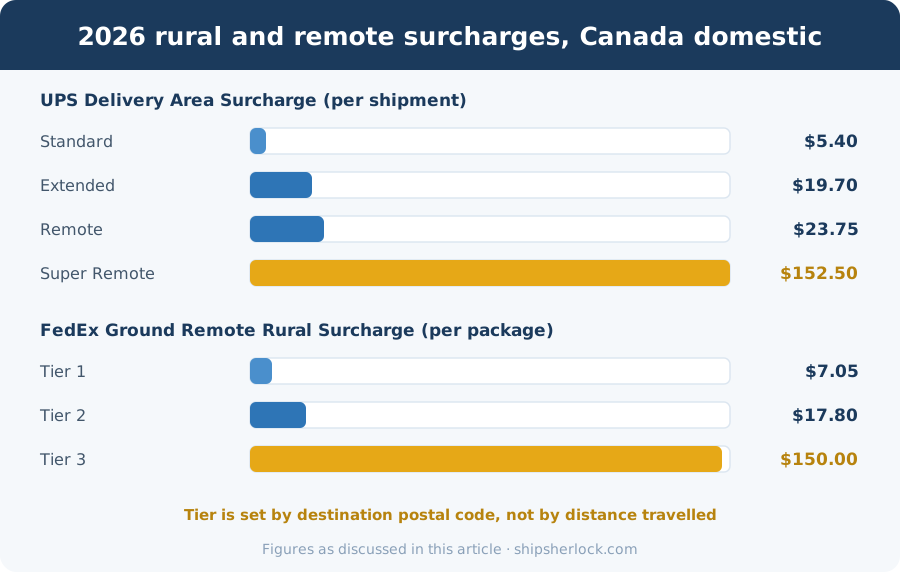
UPS Canada calls it the Delivery Area Surcharge and runs four domestic tiers. Per the 2026 UPS Canada Rate and Service Guide, the charges are $5.40 for the base tier, $19.70 for Extended, $23.75 for Remote, and $152.50 for Super Remote. All four are billed per shipment.
FedEx Ground in Canada calls it the Remote Rural Surcharge and runs three tiers: $7.05, $17.80, or $150 per package, depending on the destination postal code. There is a further $42 added when a package to one of those destinations weighs more than 100 lbs (46 kg). Those figures took effect January 5, 2026, up from $6.85, $17.30, $145 and $40.50 the year before.
FedEx Express intra-Canada handles it differently again, under the name Out-of-Delivery Area Surcharge, and it is partly weight-based. Tier B is the greater of $27.95 or $0.56 per lb per shipment. Tier C, which covers the Northwest Territories, Nunavut, Yukon and select postal codes in Newfoundland and Labrador, Quebec, Manitoba, Alberta and British Columbia, is the greater of $124.40 or $4.20 per lb per shipment.
None of that includes the residential surcharge, which stacks on top: $5.05 per delivery at UPS, $4.80 per package at FedEx.
The tier comes from the postal code, not the distance
This is the part that surprises people. The carrier is not measuring how far the truck drove. Every tier is assigned from a published list of destination postal codes, and the parcel gets whatever tier its delivery postal code sits in. UPS publishes a Domestic Delivery Area Surcharge Listing, FedEx publishes its own postal code list, and both get revised at least annually.
Two consequences follow from that.
First, the fee is completely predictable before you ship. If you know the destination postal code, you know the tier.
Second, and more usefully, the fee is completely verifiable after you ship. Every rural surcharge on your invoice is a claim that a specific postal code appears in a specific tier of a published list. That claim is either true or it is not.
Four ways this gets billed wrong
Tier misapplication. This is the expensive one. The gap between the UPS Extended tier and the Super Remote tier is over $130 on a single parcel. A postal code that gets reclassified in the annual list update, or simply gets matched to the wrong tier, produces a charge that looks plausible on an invoice line and is badly wrong.
Per shipment charged as per package. UPS bills its Delivery Area Surcharge per shipment. FedEx Ground bills its Remote Rural Surcharge per package. If you send a three-box multi-piece shipment through UPS to a rural address, you should see the surcharge once, not three times. This is one of the easiest errors to spot and one of the most commonly missed, because multi-piece shipments spread across several invoice lines.
A rural fee on a corrected address. When a carrier corrects a delivery address, the postal code can change. If the surcharge was assessed against the original postal code and never rerated against the corrected one, you may be paying a rural fee for a destination that is not rural. Any parcel carrying both an address correction fee and a rural surcharge deserves a second look.
Billed weight errors compounding. On FedEx Express Tier C, the surcharge is the greater of $124.40 or $4.20 per lb. That means a dimensional weight error does not just inflate your base rate, it inflates the rural surcharge at $4.20 for every phantom pound. Weight errors are worth catching everywhere, but on remote shipments they cost several times more.
What this actually costs
Take a seller moving 500 parcels a month with 5 percent going to rural postal codes. That is roughly 25 surcharged parcels. At the UPS Extended tier, that alone is close to $500 a month in rural fees, and that is the correct-billing scenario.
Now suppose three of those parcels get tiered as Super Remote when the postal code belongs in Extended. That single error adds roughly $400 to one month's invoice, on three parcels. Typically the sellers who find the most here are the ones shipping regularly into Atlantic Canada, northern Ontario, northern Quebec, and the territories, where tier boundaries are dense and reclassifications are frequent.
How to check your own invoices
You do not need software to start. Pull one month of invoices, filter to lines carrying a rural, remote, extended or delivery area charge, and check three things: does the destination postal code appear on the carrier's current published list, is it in the tier you were billed, and for multi-piece shipments, was the fee applied per shipment or per package as the carrier's own guide specifies.
That is tedious by hand and it is exactly the sort of check software should be doing on every parcel, every week, automatically. Rural surcharges are a good place to start an audit because the rule is published, the data is on the label, and the dollar swing per error is large.
Sources: 2026 UPS Canada Rate and Service Guide (Daily Rates); FedEx Canada 2026 rate and surcharge changes.
Related guides
Deadlines, eligibility and claim steps for the carriers covered above.
- Canadian Carrier Refund RulesFiling deadlines and eligible services for UPS, FedEx, Canada Post and Purolator, kept current.
- UPS Refund Recovery in CanadaHow UPS Guaranteed Service Refunds work and what the 15-day window covers.
- FedEx Refund Recovery in CanadaClaiming the FedEx Money-Back Guarantee, including the 2026 Canadian reinstatement.
Stop overpaying
Done reading? Start recovering.
ShipSherlock audits every invoice automatically. You pay nothing unless we find money your carrier owes you.