
What Is DIM Weight and Why It's Probably Costing You Money
Dimensional weight pricing is one of the most common sources of shipping overcharges for Canadian sellers. Here's how it works, how carriers calculate it, and what you can do about it.

ShipSherlock Team
The Box That Costs More Than It Should
You shipped a pillow. It weighs 500 grams. But your UPS invoice says you were charged for 4 kilograms. That's not a mistake in the way you might think. That's dimensional weight pricing, and it's one of the most misunderstood parts of shipping in Canada.
Dimensional weight (DIM weight) is a pricing method that carriers use to charge based on how much space a package takes up, not just how much it weighs. The idea is straightforward: a big, light box takes up the same amount of truck space as a big, heavy one. So carriers want to charge for that space.
The problem is that DIM weight calculations are a frequent source of billing errors. And most sellers never check.
How DIM Weight Is Calculated
Both UPS and FedEx use the same basic formula in Canada:
DIM Weight = Length x Width x Height / 5,000
All measurements are in centimeters, and the result is in kilograms. The carrier compares the DIM weight to the actual weight of the package and charges you whichever is higher.
Here's a quick example. Say you ship a box that measures 50cm x 40cm x 30cm and weighs 3 kg.
DIM weight = 50 x 40 x 30 / 5,000 = 12 kg
Even though the box only weighs 3 kg, you're billed for 12 kg. That's a big difference, and it's completely legitimate if the measurements are correct.
The issue is when they're not.
Where the Errors Creep In
DIM weight overcharges happen more often than you'd expect, and they come from a few places.
Measurement errors at the carrier facility. UPS and FedEx use automated scanning systems to measure packages. These systems aren't perfect. A slightly crushed box, an irregular shape, or even the position of the box on the scanner can produce measurements that don't match reality. If the scanner reads your 50cm box as 55cm, your DIM weight jumps from 12 kg to over 14 kg. That difference gets billed to you.
Rounded-up dimensions. Carriers often round measurements up to the next whole centimeter or even the next half-inch. This rounding can push your DIM weight into a higher rate tier, especially on smaller packages where every centimeter matters more.
Incorrect package type classification. Some shipments get classified with the wrong package dimensions entirely. If your standard mailer gets logged as a larger box size, the DIM weight calculation is wrong from the start.
Old rates applied to new packaging. If you recently changed your packaging to smaller boxes but your rate profile hasn't been updated, you might be paying DIM weight charges based on outdated size assumptions.
The Real Dollar Impact
For a single package, a DIM weight error might only cost you a few dollars. But if you're shipping 200 or 500 or 1,000 packages a month, those errors add up fast.
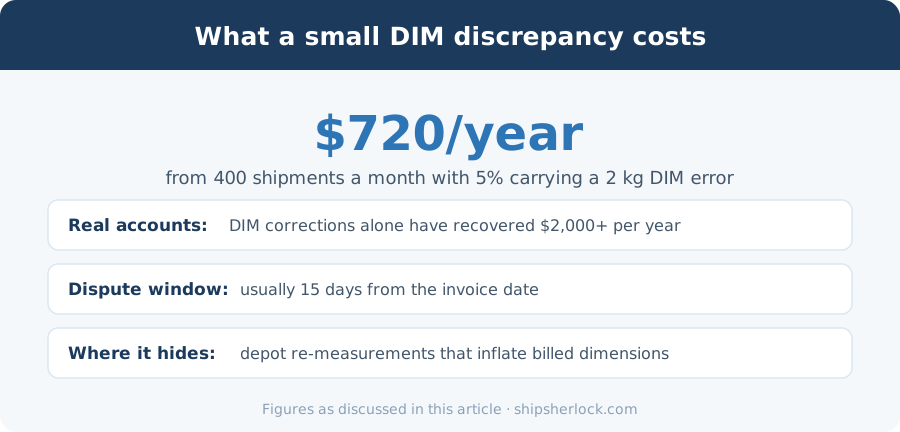
Consider a business shipping 400 parcels a month. If even 5% of those shipments have a DIM weight discrepancy of 2 kg, and you're paying roughly $1.50 per extra kilogram, that's:
400 x 5% x $1.50 x 2 = $60 per month, or $720 per year.
And that's a conservative estimate. Many businesses see DIM weight errors on a higher percentage of shipments, with larger discrepancies. We've seen accounts where DIM weight corrections alone recovered over $2,000 per year.
What You Can Do About It
Measure your own packages. Keep records of the actual dimensions and weights of your most common SKUs. If a carrier invoice shows a DIM weight that doesn't match your records, you have grounds to dispute.
Check your invoices regularly. Look at the billed weight column on your UPS or FedEx invoice. If you see packages where the billed weight is significantly higher than what you know the actual weight to be, DIM weight pricing is probably the reason.
Optimize your packaging. This sounds obvious, but it's worth saying. If you're shipping a small product in an oversized box, DIM weight pricing is going to cost you more than it should. Use the smallest box that safely holds the product. Custom-sized packaging pays for itself quickly at scale.
Dispute incorrect measurements. Both UPS and FedEx have processes for disputing DIM weight charges. You'll need your own measurement records and the tracking number. The dispute window is usually 15 days from the invoice date. Miss it and the charge stands.
Automate the audit. Checking every shipment on every invoice is tedious work, and most businesses simply don't have the time. That's the kind of thing a shipping audit service is built for. ShipSherlock checks every line item on every invoice automatically, flags DIM weight discrepancies, and files disputes before the deadline passes.
It's Not Just DIM Weight
DIM weight overcharges are just one of six types of billing errors that show up on carrier invoices. Late delivery refunds, duplicate charges, voided shipments that still get billed, incorrect surcharges, and address correction fees are all common too.
The pattern is the same across all of them: the carrier doesn't proactively fix the error, and the filing window is short. If nobody checks, the money is gone.
For Canadian sellers shipping with UPS, FedEx, Canada Post, or Purolator, even a basic audit can recover thousands of dollars per year. And with an automated service like ShipSherlock, you don't have to do any of the checking yourself. We pull your invoices daily, flag every error we find, and file claims automatically.
If you're curious how much DIM weight errors and other overcharges might be costing your business, try our savings calculator or sign up for a free audit. You only pay if we recover money.
Related guides
Deadlines, eligibility and claim steps for the carriers covered above.
- Canadian Carrier Refund RulesFiling deadlines and eligible services for UPS, FedEx, Canada Post and Purolator, kept current.
- UPS Refund Recovery in CanadaHow UPS Guaranteed Service Refunds work and what the 15-day window covers.
- FedEx Refund Recovery in CanadaClaiming the FedEx Money-Back Guarantee, including the 2026 Canadian reinstatement.
- Shipping Audit for Canadian SellersWhat a full invoice audit checks, and how much sellers typically recover.
Stop overpaying
Done reading? Start recovering.
ShipSherlock audits every invoice automatically. You pay nothing unless we find money your carrier owes you.