
How to Read Your FedEx Invoice: A Line-by-Line Guide for Canadian Sellers
Learn how to read your FedEx invoice, spot the surcharges that inflate your shipping costs, and catch billing errors before the 15-day dispute window closes.

ShipSherlock Team
Most Canadian sellers pay their FedEx invoice the same way they pay their hydro bill. Glance at the total, wince, pay it. That habit costs real money, because a FedEx invoice is not a simple receipt. It is a stack of base rates, surcharges, and adjustments, and any one of those lines can be wrong.
Here is how to actually read the thing, and what to check before you pay.
Why this matters right now
FedEx raised rates by an average of 5.9 percent for 2026, and the surcharge list keeps growing. On top of that, FedEx reinstated its money-back guarantee for Canadian payors on select Express services as of February 12, 2026. That means late deliveries on eligible services are refundable again, but only if you catch them, and only if you act within the deadline. If you are not reading your invoice, you are leaving both billing errors and refund credits on the table.
The clock you need to know: 15 days
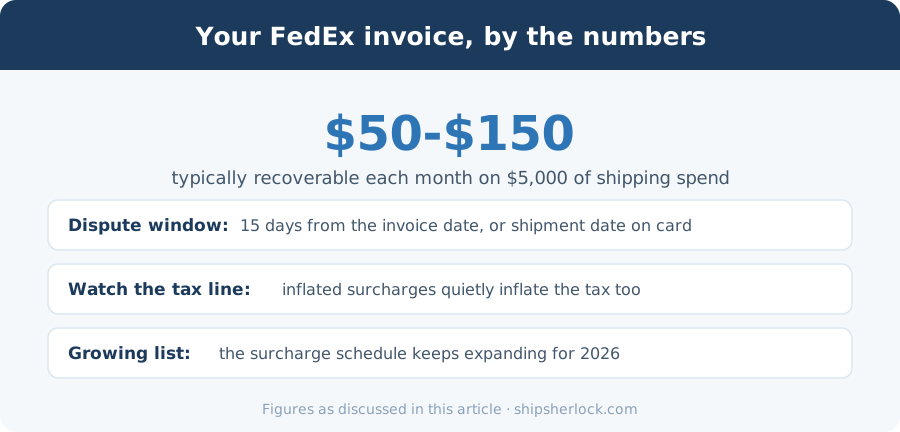
Before anything else, know this. FedEx gives you 15 days from the invoice date to dispute a charge on an invoiced shipment. If you pay by credit card, it is 15 days from the shipment date. Miss that window and even a legitimate error usually becomes your cost to eat. This is the single biggest reason invoices need to be reviewed weekly, not quarterly.
The main sections of a FedEx invoice
Invoice summary. The top of the invoice shows the invoice number, invoice date, account number, and total due. Note the invoice date. Your 15-day dispute clock starts here.
Shipment detail lines. Each shipment gets its own block showing the tracking number, ship date, service type, origin and destination, billed weight, and the base transportation charge. This is where most errors hide.
Surcharges and fees. Under each shipment, FedEx itemizes the extras. Common ones for Canadian sellers include the fuel surcharge, residential delivery surcharge, delivery area surcharge for remote postal codes, additional handling for packages that are heavy or oddly shaped, address correction fees, and seasonal demand surcharges that appear during peak periods.
Adjustments and other charges. This section captures rebills, weight adjustments, and dimensional weight corrections made after pickup. Treat every line here with suspicion, because this is where FedEx changes what you thought you agreed to pay.
The five things to check on every invoice
1. Billed weight versus actual weight. FedEx bills the greater of actual weight or dimensional weight. If the billed weight looks higher than what you shipped, check the dimensions FedEx recorded. Automated scanners get it wrong more often than you would expect, especially with soft packaging that compresses in transit.
2. Service type matches what you bought. If you paid for FedEx Ground and the line says an Express service, or vice versa, the rate will be wrong too.
3. Residential surcharges on commercial addresses. This is one of the most common errors we see. A delivery to a storefront, warehouse, or office gets flagged as residential and picks up an extra charge. Each instance is typically in the range of a few dollars to over ten dollars, and for a store shipping hundreds of parcels a month, that adds up to hundreds of dollars in recoverable charges.
4. Address correction fees. FedEx charges a fee when it corrects an address. Sometimes the correction is real. Often it is a suite number reformatted or a postal code adjusted, and the fee is disputable.
5. Late deliveries on guaranteed services. With the money-back guarantee back for Canadian payors on eligible Express services, a delivery that arrives even one minute past the commitment time can qualify for a full refund of shipping charges. FedEx does not send you a note when this happens. You have to compare the delivery scan against the commitment time yourself, shipment by shipment.
What a review typically recovers
Industry audits consistently find that a meaningful share of parcel invoices contain some form of error or refundable event. For a typical Canadian seller shipping a few hundred FedEx parcels a month, a careful monthly review typically surfaces somewhere between one and three percent of total spend in disputable charges and refund credits. On $5,000 a month in shipping, that is roughly $50 to $150, every month, that you either claim or forfeit.
The honest problem: nobody has time for this
Reading one invoice line by line takes an evening. Doing it every week, against commitment times and your negotiated rates, is a part-time job. That is exactly why FedEx and every other carrier profit from billing errors. The dispute process works, but it is designed to reward whoever shows up, and most sellers never do.
ShipSherlock does the showing up for you. Connect your FedEx account and it reads every invoice automatically, flags overcharges and late deliveries, and files the claims inside the 15-day window.
Try the free shipping audit and see what your last invoices have been hiding.
Related guides
Deadlines, eligibility and claim steps for the carriers covered above.
- Canadian Carrier Refund RulesFiling deadlines and eligible services for UPS, FedEx, Canada Post and Purolator, kept current.
- FedEx Refund Recovery in CanadaClaiming the FedEx Money-Back Guarantee, including the 2026 Canadian reinstatement.
- Shipping Audit for Canadian SellersWhat a full invoice audit checks, and how much sellers typically recover.
Stop overpaying
Done reading? Start recovering.
ShipSherlock audits every invoice automatically. You pay nothing unless we find money your carrier owes you.