
How to Read Your UPS Invoice and Catch the Overcharges Hiding in It
A plain-language walkthrough for Canadian sellers on reading a UPS invoice line by line, decoding the surcharge codes, and spotting the charges worth disputing.

ShipSherlock Team
Most Canadian sellers I talk to do one of two things with their weekly UPS invoice. They glance at the total, wince, and pay it. Or they do not open it at all because the line items may as well be written in another language. Both habits cost money. UPS invoices are dense on purpose, and the charges that get added after a package ships are exactly the ones nobody checks.
Here is how to actually read the thing, what the confusing codes mean, and which lines are worth a second look.
Start with the structure, not the total
A UPS invoice is not one bill. It is a stack of individual shipment records grouped under a summary page. The summary shows your account number, the invoice date, the billing period, and the amount due. Useful for your bookkeeper, useless for catching errors. The money problems live in the detail pages further down, where each tracking number gets its own block of charges.
For every shipment you will see a base transportation charge, then a series of add-on lines stacked underneath it. Those add-ons are where you want to spend your attention. The base rate is what you agreed to. The add-ons are what UPS decided applied to that specific parcel, often based on data it measured at the depot, not what you entered when you created the label.
Decode the add-on lines
A few charge types show up on nearly every Canadian seller's invoice. Knowing what each one means is half the battle.
Additional Handling. This applies when a package is heavy, oversized, or oddly shaped. For 2026, UPS raised these fees by roughly 6.8 to 12.5 percent depending on zone, and as of January 26, 2026 it added a cubic volume trigger. A package over 10,368 cubic inches now picks up Additional Handling even if its weight looks normal. If you ship anything bulky, this line will appear a lot.
Large Package Surcharge. A bigger version of the same idea. As of January 26, 2026, anything over 17,280 cubic inches triggers it, and the residential version can run well over 300 dollars per package. One mismeasured skid-sized box can blow up an entire week's shipping cost.
Residential Surcharge. Added when UPS classifies the delivery address as a home rather than a business. The catch is that UPS decides this, and it gets it wrong often. A home-based business, a unit in a mixed commercial building, or a storefront with apartments above can all get flagged as residential when they should not be.
Address Correction. Charged when UPS says the address you provided was incomplete or wrong and it had to fix it to deliver. Sometimes fair. Sometimes the address was fine and the charge is simply incorrect.
Fuel Surcharge. A percentage applied on top of the transportation charge and several accessorials. It changes weekly. You will not usually dispute this one, but you should know it compounds on everything else, which is another reason wrong base charges hurt more than they look.
Below all of that you will see GST or HST applied according to the destination province, five percent in Alberta and the western provinces, thirteen percent in Ontario, fifteen percent in New Brunswick, Newfoundland and Labrador, and PEI. Tax is calculated on the charges above it, so an inflated surcharge quietly inflates the tax line too.
The three lines worth checking every time
You do not need to audit all of it. Focus where errors cluster.
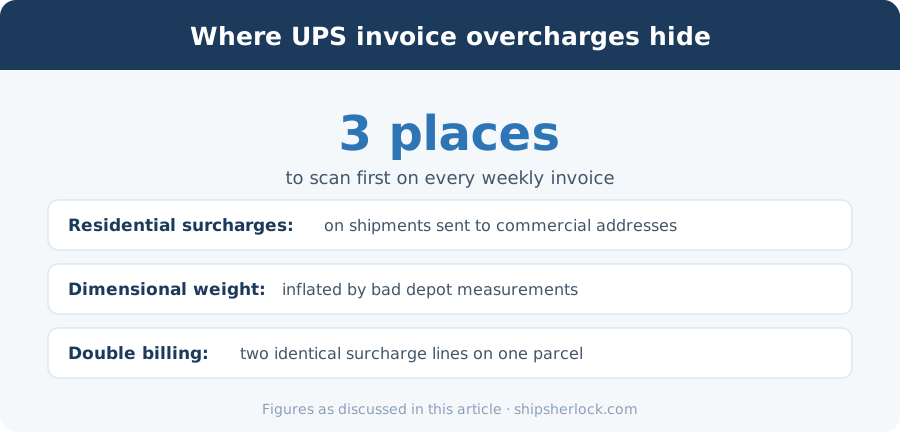
First, dimensional weight. Find the billed weight on each shipment and compare it to what you know the package actually weighs and measures. UPS bills on whichever is greater, actual or dimensional. If the billed weight looks high for a small item, the dimensions UPS captured are probably wrong, and everything calculated from them is wrong too.
Second, the residential flag on business deliveries. Scan for the residential surcharge on shipments you sent to commercial addresses. Each wrong flag is a small charge, but they repeat shipment after shipment, week after week.
Third, duplicate or phantom charges. Two Additional Handling lines on one parcel, a surcharge on a shipment that was never picked up, or a charge for a package you can prove was delivered late. These are pure billing errors and they are the most clear-cut to claim back.
What a typical week looks like
Say you ship 200 parcels in a week. If even a handful carry a wrongly applied residential surcharge, a couple get dimensional weight inflated by bad depot measurements, and one large package gets miscoded, you are typically looking at recoverable amounts in the tens of dollars that week. Multiply that across a year and it usually lands in the hundreds to low thousands for a mid-volume Canadian shop. That is money you already earned and overpaid, not a discount you have to negotiate.
You do not have to do this by hand
Reading one invoice carefully is doable. Reading 52 of them a year, cross-checking every line against carrier rules that change mid-year, is not a good use of your time. That is the entire reason we built ShipSherlock. It connects to your carrier account, reads every invoice line the way I just described, flags the charges that look wrong, and prepares the dispute. You review and approve.
If you have never checked, the safest assumption is that some of these charges are wrong right now. Find out for free.
Related guides
Deadlines, eligibility and claim steps for the carriers covered above.
- Canadian Carrier Refund RulesFiling deadlines and eligible services for UPS, FedEx, Canada Post and Purolator, kept current.
- UPS Refund Recovery in CanadaHow UPS Guaranteed Service Refunds work and what the 15-day window covers.
- Shipping Audit for Canadian SellersWhat a full invoice audit checks, and how much sellers typically recover.
Stop overpaying
Done reading? Start recovering.
ShipSherlock audits every invoice automatically. You pay nothing unless we find money your carrier owes you.