
Residential Surcharge Disputes: What Canadian Sellers Should Do When Carriers Misclassify an Address
UPS and FedEx add a residential surcharge to every package they think goes to a home. Here is how Canadian sellers can spot misclassified commercial addresses and dispute residential surcharges.

ShipSherlock Team
Every time UPS or FedEx decides a delivery address is a home instead of a business, they add a residential surcharge to your invoice. It is one of the most common accessorial charges in parcel shipping, and one of the most commonly wrong.
Here is the part most Canadian sellers do not know. The carrier does not check the address at delivery. It checks a database. And that database is frequently out of date or just incorrect. When it tags a storefront, warehouse, or office as residential, you pay a surcharge you never owed, on every single shipment to that address, until someone catches it.
What the residential surcharge is
Both UPS and FedEx define a residential delivery as any shipment going to a home or private residence, including a business operated out of a home. The surcharge typically runs in the range of five to eight dollars per package, and it went up again with the 2026 rate changes. On top of that, residential addresses often trigger a delivery area surcharge as well, so a single misclassification can stack two separate fees onto one parcel.
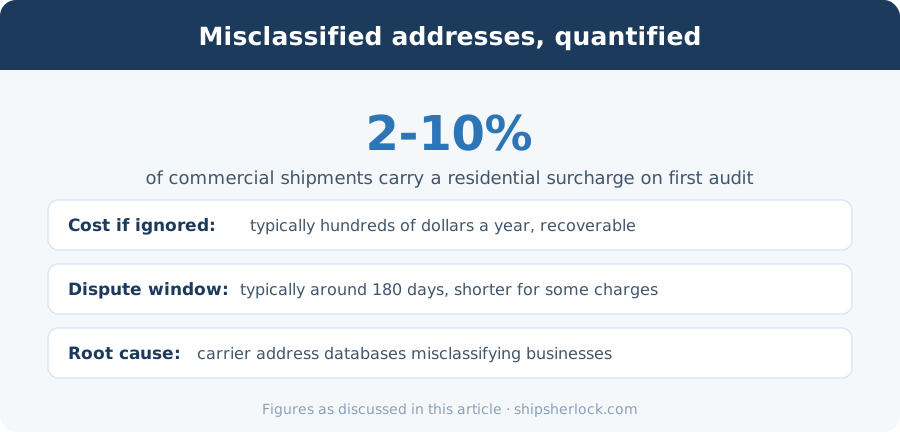
For a seller shipping a few hundred packages a month, even a modest misclassification rate adds up. If 5 percent of your commercial deliveries are wrongly tagged residential, that is typically hundreds of dollars a year in charges you can recover or prevent.
How addresses get misclassified
Carriers classify addresses using their own internal databases, not a live check of the building. The usual failure cases:
Mixed-use buildings. A retail unit below apartments often inherits a residential flag for the whole street address.
New commercial developments. A business park that used to be farmland or housing can stay flagged residential for years after construction.
Home-based businesses. This one cuts the other way. If your customer runs a business from home, the carrier will still classify it residential, and that charge is legitimate. Do not waste dispute effort here.
Rural and small-town addresses. Outside major centres, carrier databases are thinner. A commercial address on a rural route in Ontario or the Prairies is more likely to be misread than a downtown Toronto office tower.
Shipper-designated residential. If your checkout or shipping software marks an address residential, the carrier takes your word for it. A wrong default setting in your Shopify or WooCommerce shipping app can quietly tag every order residential.
How to spot it on your invoice
Pull a recent UPS or FedEx invoice and look at the accessorial charges attached to each tracking number. The line will read something like Residential Surcharge, Residential Delivery Charge, or Delivery Area Surcharge Residential.
Then cross-check the delivery addresses. You are looking for shipments to businesses that carry a residential charge. Obvious candidates: deliveries to other retailers, offices, clinics, restaurants, or any address with a unit or suite number in a commercial building. If you ship B2B at all, check every one of those tracking numbers.
How to dispute a residential surcharge
The dispute itself is simple. Proving the classification is the work.
Step one, gather evidence. You need to show the address is commercial. Useful proof includes a Google Maps listing showing the business at that address, the receiving company's website with the address on its contact page, or a photo of the storefront or signage.
Step two, file within the billing window. Both carriers expect billing disputes within a limited period after the invoice date, typically around 180 days but shorter for some charge types. File promptly rather than testing the boundary.
Step three, submit through the billing centre. In the UPS Billing Center or FedEx Billing Online, select the invoice, pick the charge, choose the dispute reason related to incorrect surcharge or address classification, and attach your evidence. Reference the tracking number and state plainly: this is a commercial address, here is the proof, please reverse the residential surcharge.
Step four, request a database correction. Reversing one charge fixes one invoice. Ask the carrier to correct the address classification in their system too, otherwise the same surcharge comes back next week.
What recovery looks like in practice
A typical Canadian seller doing steady B2B volume finds residential surcharges on somewhere between 2 and 10 percent of commercial shipments when they first audit. At five to eight dollars per occurrence, a seller shipping 500 parcels a month with even a small B2B mix typically recovers or prevents a few hundred to a couple thousand dollars a year from this one charge type. Not life-changing on its own, but this is exactly the kind of leak that compounds with fuel surcharges, address corrections, and late deliveries into real money.
The catch: nobody has time to cross-check addresses
Auditing residential surcharges by hand means comparing every accessorial line against every delivery address, every week. Almost nobody does it, which is why the charges persist.
ShipSherlock does the cross-checking automatically. Connect your carrier accounts and it flags suspect charges on every invoice, including residential surcharges on addresses that look commercial, and helps you file the dispute before the billing window closes.
Try the free shipping audit and see what your last invoices are hiding.
Related guides
Deadlines, eligibility and claim steps for the carriers covered above.
- Canadian Carrier Refund RulesFiling deadlines and eligible services for UPS, FedEx, Canada Post and Purolator, kept current.
- UPS Refund Recovery in CanadaHow UPS Guaranteed Service Refunds work and what the 15-day window covers.
- FedEx Refund Recovery in CanadaClaiming the FedEx Money-Back Guarantee, including the 2026 Canadian reinstatement.
Stop overpaying
Done reading? Start recovering.
ShipSherlock audits every invoice automatically. You pay nothing unless we find money your carrier owes you.