
5 Shipping Invoice Errors Costing Canadian E-commerce Sellers Thousands
Most Canadian e-commerce businesses overpay on shipping without realizing it. Here are the 5 most common billing errors from UPS, FedEx, and Canada Post — and how to catch them.

ShipSherlock Team
The Hidden Cost of Unchecked Shipping Invoices
If you're running a Canadian e-commerce business, shipping is likely your second or third largest operating expense after inventory and staff. But here's what most sellers don't realize: carrier billing systems make errors at a rate of 1-5% of all charges.
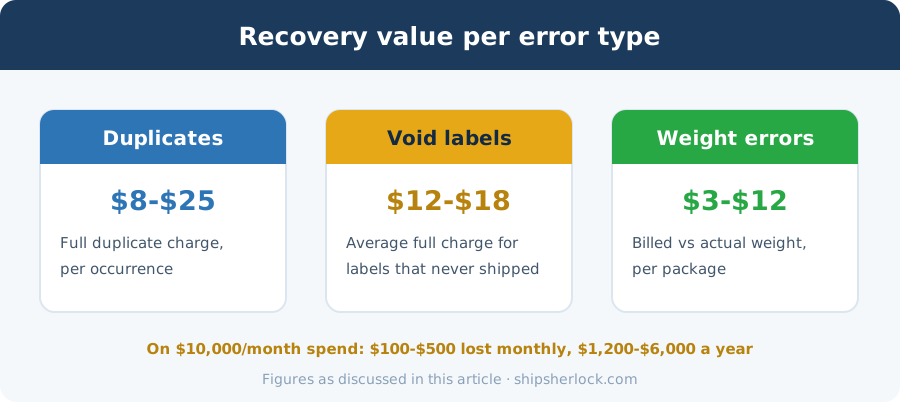
On a $10,000/month shipping spend, that's $100 to $500 every month in overcharges that go unnoticed. Over a year, you could be losing $1,200 to $6,000 — pure profit walking out the door.
Here are the five most common billing errors we see when auditing Canadian shipping invoices.
1. Duplicate Charges
The most straightforward error: the same tracking number appears twice on your invoice. This happens more often than you'd expect, particularly when:
- A package is rescanned at a sorting facility
- A label is reprinted and both get charged
- System glitches during high-volume periods (holiday season, Prime Day)
Recovery value: Full amount of the duplicate charge (typically $8-$25 per occurrence).
How to catch it: Sort your invoice by tracking number. Any number appearing more than once is likely a duplicate.
2. Void/Cancelled Shipments Still Billed
You created a shipping label but the package was never picked up. Maybe the order was cancelled, or you reprinted with a different service. The carrier charged you anyway.
The tell: a tracking number with no movement scans. No pickup scan, no departure scan, no delivery — but a charge on your invoice.
Recovery value: Full shipping charge for the voided label (average $12-$18 in Canada).
How to catch it: Look for tracking numbers with zero scan events. If a label was never physically used, it should not appear on your bill.
3. Incorrect Dimensional Weight
Carriers use "dimensional weight" (DIM weight) to charge for large but light packages. The formula is: Length × Width × Height ÷ DIM factor. In Canada, UPS and FedEx typically use a DIM factor of 5,000 (for centimetres and kilograms).
Errors occur when:
- Measurements are rounded up incorrectly
- The DIM factor doesn't match your contract rate
- Actual weight should apply (actual weight exceeds DIM weight)
Recovery value: Difference between billed weight and correct weight at your contracted rate (often $3-$12 per package).
How to catch it: Compare the billed weight against the package's actual dimensions. This requires knowing your negotiated DIM factor.
4. Residential Delivery Surcharge on Commercial Addresses
Carriers add a surcharge ($4-$6) for deliveries to residential addresses. But their address classification databases aren't perfect. Businesses operating from mixed-use buildings, commercial condos, or industrial parks often get incorrectly flagged as residential.
If you're shipping to a business that's been incorrectly classified, you're paying the surcharge on every single delivery to that address.
Recovery value: $4-$6 per incorrectly flagged delivery. If you ship regularly to the same commercial addresses, this compounds quickly.
How to catch it: Cross-reference addresses flagged as "residential" against a commercial address database. Business addresses with suite numbers are commonly misclassified.
5. Late Delivery (Guaranteed Service Refund)
This is the biggest category — typically 60-70% of all recoverable charges. When a carrier guarantees a delivery time and misses it, you're entitled to a full refund of the shipping charges. UPS and FedEx both offer this, and both require you to file a claim within 15 days.
Recovery value: Full shipping charge including fuel surcharge (average $15-$30 per late delivery).
How to catch it: Compare the guaranteed delivery time (based on service level and lane) against the actual delivery timestamp. Any gap means you're owed money.
Why These Errors Persist
Carriers aren't deliberately overcharging you (usually). Their billing systems process hundreds of millions of packages per month. At that scale, even a 99.5% accuracy rate means millions of billing errors industry-wide.
The issue is asymmetric incentives: carriers have no reason to self-audit in your favour. If they overcharge you, they keep the money unless you specifically dispute it. If they undercharge you, they'll catch it quickly.
What Canadian Sellers Should Do
The minimum: review your invoices monthly and spot-check for the five errors above. The ideal: automate the entire process. An automated audit system catches every error on every invoice, files claims within the deadline, and recovers money you'd never notice was missing.
The ROI on shipping auditing is effectively infinite — you pay nothing unless overcharges are found. It's not a cost centre, it's a profit recovery tool.
Related guides
Deadlines, eligibility and claim steps for the carriers covered above.
- Canadian Carrier Refund RulesFiling deadlines and eligible services for UPS, FedEx, Canada Post and Purolator, kept current.
- UPS Refund Recovery in CanadaHow UPS Guaranteed Service Refunds work and what the 15-day window covers.
- FedEx Refund Recovery in CanadaClaiming the FedEx Money-Back Guarantee, including the 2026 Canadian reinstatement.
- Canada Post OverchargesOn-Time Delivery Guarantee claims and the 30-business-day deadline.
Stop overpaying
Done reading? Start recovering.
ShipSherlock audits every invoice automatically. You pay nothing unless we find money your carrier owes you.