
5 Shipping Overcharges Canadian E-Commerce Sellers Miss Every Month
Canadian sellers lose thousands to shipping billing errors they never catch. Here are the 5 most common overcharge types from UPS, FedEx, Canada Post, and Purolator — and how to spot them.

ShipSherlock Team
Your Shipping Invoices Are Almost Certainly Wrong
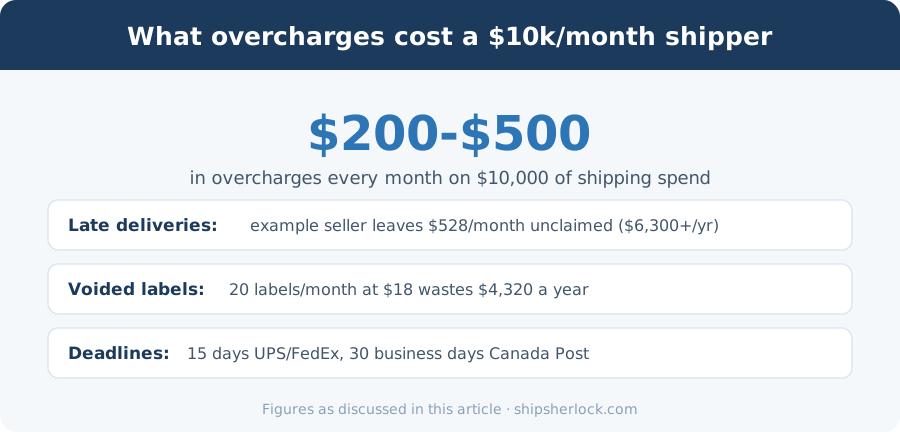
Carrier billing errors are not rare edge cases. Industry data consistently shows that 2% to 5% of all shipping charges contain some form of billing error — and the vast majority go undetected. For a Canadian e-commerce seller spending $10,000 per month on shipping, that translates to $200 to $500 in overcharges every single month.
The problem is not that carriers are deliberately overbilling. Shipping billing is genuinely complex: dimensional weight calculations, zone-based pricing, fuel surcharges that change monthly, accessorial fees with dozens of conditions. Errors happen constantly, and they almost always favour the carrier.
Here are the five overcharge types we see most often when auditing Canadian shippers.
1. Guaranteed Service Refund (GSR) Violations
What it is: UPS, FedEx, and Purolator all offer service guarantees on express shipments. If a package arrives even one minute late, you are entitled to a full refund of the shipping charge. Canada Post offers a similar guarantee on Priority and Xpresspost services.
Why it gets missed: Carriers do not proactively issue these refunds. You have to identify the late delivery yourself and file a claim — usually within 15 days for UPS and FedEx, and 30 business days for Canada Post. Most shippers either do not track delivery times closely enough or simply do not have time to file individual claims.
The real cost: A mid-size Canadian seller shipping 400 express packages per month with an average late delivery rate of 6% and an average shipping cost of $22 is leaving roughly $528 per month unclaimed — over $6,300 per year.
How to catch it: Cross-reference every express tracking number with actual delivery time. Compare against the carrier's published service standard for that lane. If it is late by even a minute, file the claim.
2. Duplicate Charges
What it is: The same shipment appears twice on your invoice. This can happen when a package is rescanned at a sorting facility, when a label is reprinted, or when a system glitch creates a duplicate billing record.
Why it gets missed: Invoices from UPS and FedEx can run to hundreds of line items. Duplicates are not always on consecutive lines — they can be pages apart. Unless you are systematically checking for duplicate tracking numbers, they blend into the noise.
The real cost: Duplicates are less frequent than GSR violations — typically affecting 0.1% to 0.5% of shipments — but each one costs the full shipping amount. On a $25 shipment, a duplicate means you paid $50 for one delivery.
How to catch it: Sort your invoice by tracking number and flag any duplicates. Automated tools can do this instantly; manually, it requires exporting the invoice to a spreadsheet and running a duplicate check.
3. Voided Shipments Still Billed
What it is: You create a shipping label, then cancel it — perhaps the order was cancelled, or you reprinted the label with a correction. The voided label should not be charged. But carriers sometimes bill for voided labels anyway, especially if the void was processed close to the billing cutoff.
Why it gets missed: Shippers assume that voiding a label in their shipping software automatically removes the charge. In most cases it does, but timing matters. If the void request does not reach the carrier's billing system before the invoice is generated, the charge sticks — and nobody follows up.
The real cost: A seller who voids 20 labels per month at an average of $18 each could be paying $360/month for shipments that never moved. Over a year, that is $4,320 in pure waste.
How to catch it: Maintain a log of voided labels and cross-reference against your invoice. Any voided tracking number that appears as a charge should be disputed immediately.
4. Incorrect Dimensional Weight
What it is: Carriers use whichever is greater — actual weight or dimensional weight — to calculate shipping cost. Dimensional weight is calculated by multiplying length x width x height and dividing by a dimensional factor (typically 5,000 for metric measurements in Canada). If the carrier's measurement of your package dimensions is even slightly off, the dimensional weight — and therefore the charge — can jump to a higher tier.
Why it gets missed: Dimensional weight disputes require knowing the actual dimensions of each package you shipped. If you use standard box sizes, you can catch these. If your packaging varies, it is harder to verify. Carriers measure packages with automated scanners at sorting facilities, and these scanners occasionally misread dimensions — particularly on irregularly shaped or soft-sided packages.
The real cost: A package measuring 40 x 30 x 25 cm has a dimensional weight of 6 kg. If the scanner reads it as 45 x 35 x 28 cm, the dimensional weight jumps to 8.82 kg — potentially moving the shipment to a higher pricing tier. On a single package, the difference might be $3 to $8. Across 200 shipments per month with a 3% error rate, that is $18 to $48/month in overcharges from this category alone.
How to catch it: If you ship in standard box sizes, set up a table of expected dimensional weights for each box. Flag any charge where the billed dimensional weight exceeds the expected value for that box size.
5. Incorrect Surcharges
What it is: Carriers apply a variety of surcharges: residential delivery, extended area, oversized package, signature required, fuel surcharge, and more. Each surcharge has specific conditions — and they are sometimes applied incorrectly.
The most common incorrect surcharges we see in Canadian shipping:
- Residential surcharge on commercial addresses: Carriers use databases to classify addresses as residential or commercial. These databases are not always accurate, especially for businesses operating out of mixed-use buildings or home offices. If your customer's business is misclassified as residential, you pay an extra $4 to $6 per package.
- Extended area surcharge applied to urban areas: Extended area fees are meant for remote or rural delivery zones. Boundary errors in the carrier's postal code mapping can incorrectly tag urban addresses as extended area.
- Fuel surcharge discrepancies: Fuel surcharges change monthly (or more frequently). The rate applied should match the published rate for the ship date, not the invoice date. Small timing mismatches can result in overcharges.
The real cost: Residential surcharge errors alone can cost a seller $4 to $6 per affected package. If 5% of your 300 monthly shipments are incorrectly flagged as residential, that is $60 to $90/month — or up to $1,080/year — from a single surcharge type.
How to catch it: Review surcharge line items against the actual delivery addresses. For residential surcharge disputes, verify that the address is indeed a business. For extended area charges, check the carrier's published extended area postal code list.
The Compound Effect of Shipping Overcharges
Each of these five overcharge types might seem minor in isolation. But they compound. Here is what a mid-size seller typically leaves on the table each month.
GSR violations: $528
Voided shipments billed: $360
Duplicate charges: $75
Incorrect surcharges: $75
Dimensional weight errors: $30
Total: $1,068 a month, or $12,816 a year.
For a business operating on typical e-commerce margins of 10% to 20%, recovering $12,800 per year in shipping overcharges is equivalent to generating an additional $64,000 to $128,000 in revenue.
Why These Errors Go Unnoticed
Three factors work against manual detection:
Volume: A seller shipping 500 packages per month across two carriers generates thousands of invoice line items. Manually reviewing each one is impractical.
Complexity: Each overcharge type requires different data — tracking numbers, delivery times, package dimensions, address classifications, surcharge schedules. No single report gives you everything.
Time pressure: Filing disputes has deadlines. UPS and FedEx typically require claims within 15 days of the invoice date. Miss the window and the money is gone regardless of whether the charge was valid.
Automate the Recovery
ShipSherlock audits every line item on every shipping invoice across all four major Canadian carriers — UPS, FedEx, Canada Post, and Purolator. We automatically detect all five overcharge types listed above, file disputes on your behalf, and track each claim through to resolution.
You pay nothing unless we recover money your carrier owes you.
Run a free audit on your shipping invoices and see exactly how much you have been overpaying. Most sellers are surprised by the total.
Related guides
Deadlines, eligibility and claim steps for the carriers covered above.
- UPS Refund Recovery in CanadaHow UPS Guaranteed Service Refunds work and what the 15-day window covers.
- FedEx Refund Recovery in CanadaClaiming the FedEx Money-Back Guarantee, including the 2026 Canadian reinstatement.
- Canada Post OverchargesOn-Time Delivery Guarantee claims and the 30-business-day deadline.
- Canadian Carrier Refund RulesFiling deadlines and eligible services for UPS, FedEx, Canada Post and Purolator, kept current.
Stop overpaying
Done reading? Start recovering.
ShipSherlock audits every invoice automatically. You pay nothing unless we find money your carrier owes you.